



2025 Mazda CX-50 vs. Toyota 4Runner: Off-Road and On-Road Performance in Fort Worth, Texas
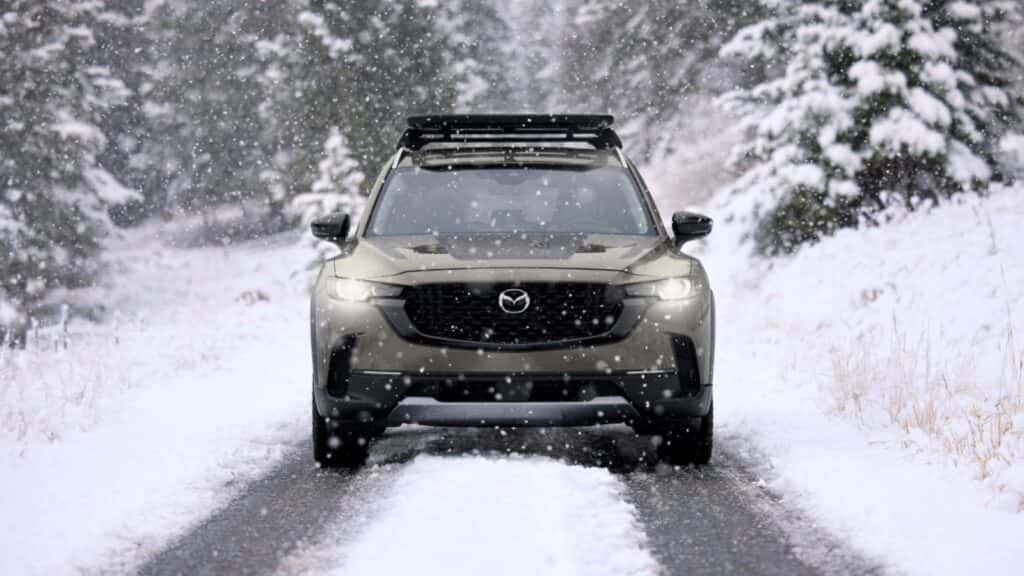
Image provided by Mazda
Fort Worth drivers face a tough choice between the 2025 Mazda CX-50 and the Toyota 4Runner, two SUVs that offer very different strengths. The CX-50 caters to daily commuters with its decent fuel efficiency, smooth rides, and a touch of off-road capability. The 4Runner is built for weekend warriors who need substantial towing power and robust construction. Let’s take a closer look at how these two vehicles perform on Dallas-Fort Worth highways and Texas backroads so you can decide which fits your lifestyle.
Off-Road Performance Comparison
The backbone of each SUV says a lot about its off-road personality. The 4Runner uses a traditional truck-style body-on-frame platform favored by off-road enthusiasts. The Mazda CX-50 uses a car-based unibody that provides a smoother ride. The 4Runner can tow up to 6,000 pounds when properly equipped. The CX-50 tows 2,000 pounds in standard form and up to 3,500 pounds with a turbo engine and towing package.
Every CX-50 comes standard with all-wheel drive. Its Trail Mode adjusts power delivery for better traction on loose surfaces, but it can’t match the 4Runner’s serious off-roading credentials. The Toyota gains a clear advantage on rough terrain with a rear limited-slip differential on all trims, while the four-wheel-drive trims add Active Traction Control and a two-speed transfer case with high/low settings.
However, even with the 4Runner’s off-roading advantage, the CX-50 can carry more cargo weight. Its maximum payload is 1,595 pounds compared to the 4Runner’s 895 pounds. That means more capacity for camping gear, sports equipment, or weekend hauls. But hard-core off-roaders will still likely gravitate toward the 4Runner’s proven durability and huge aftermarket support. Your choice depends on whether you need a vehicle for practical daily use or serious weekend adventures.
Ground Clearance, Suspension, and Power: How the CX-50 and 4Runner Compare
Toyota gives the new 4Runner real power with a turbocharged 2.4-liter engine, producing 278 horsepower and 317 lb-ft of torque. If opting for a hybrid, you’ll get the same turbo paired with a 48-horsepower electric motor for added power. The hybrid Trailhunter can reach 60 mph in 6.7 seconds, while the standard version takes 7.5 seconds. But the trade-off is that the bulky 5,111-pound 4Runner riding on its traditional frame doesn’t ride smoothly on rough roads.
Mazda offers three CX-50 power options. The base 2.5-liter engine generates 187 horsepower and reaches 60 mph in 8.5 seconds. Upgrade to the turbocharged 2.5-liter to obtain 256 horsepower on premium fuel or 227 on regular, cutting the 0 to 60 mph to 7.5 seconds. The hybrid splits the difference with 219 horsepower and a 7.6-second sprint while using less fuel. The CX-50’s suspension feels much smoother than the 4Runner’s, keeping things stable on all road conditions.
Ground clearance says a lot about what these SUVs were built to do. The CX-50 sits 8.3 to 8.6 inches off the ground, depending on the trim. The 4Runner offers more clearance, but the CX-50’s height is well-suited for typical North Texas trips. Mazda designed this SUV with comfort on the road in mind, but it handles dirt roads surprisingly well for those weekend escapes.
City Driving Performance Analysis
Around Fort Worth, the differences between these vehicles are clear. The 4Runner feels bulky in city driving, with limited grip and noticeable sway. In contrast, the CX-50 offers responsive steering and a smooth, quiet ride that suits city and highway driving. Fuel economy is a major win for the Mazda, obtaining 25 mpg in the city and 31 mpg on the highway. The 4Runner reaches 20 mpg in the city and 26 mpg on the highway.
Interior Design
The updated 4Runner adds modern technology, with a 14-inch touch screen in the higher trims, while the base models come with an 8-inch display. Most 4Runners can seat five, although certain versions offer a third row for up to seven passengers. The cabin prioritizes durability over luxury.
The CX-50 seats five comfortably with 31.4 cubic feet of cargo space behind the back seats, expanding to 56.3 cubic feet with the seats folded. Front passengers enjoy 41.7 inches of legroom, while the rear-seat space ranges from 37.8 to 39.8 inches, depending on the trim. The interior looks and feels premium, with materials similar to luxury brands. A 10.25-inch screen with Mazda Connect comes standard, along with wireless Apple CarPlay and Android Auto, and optional Alexa integration. The higher trims add panoramic moonroofs, leather-trimmed seats, and ventilated front seats.
Find Your Perfect SUV at Hiley Mazda of Fort Worth
Your choice depends on which vehicle fits your lifestyle. The 4Runner is built for serious off-roading with no-nonsense toughness and lots of aftermarket support. But the CX-50 makes more sense for most Fort Worth drivers. It handles better around town, has better fuel economy, and won’t empty your bank account.
To see what the CX-50 can do, contact Hiley Mazda of Fort Worth to schedule a test-drive. Visit our dealership at 9120 West Freeway. Our team is ready to help you Monday through Saturday, 9 a.m. to 8 p.m.
0 comment(s) so far on 2025 Mazda CX-50 vs. Toyota 4Runner: Off-Road and On-Road Performance in Fort Worth, Texas